

中文(简体)
Why Do Your Eyes Feel Heavy After Forehead Botox? Does Botox Spread to the Eyelids?
Why Do Your Eyes Feel Heavy After Forehead Botox? Does Botox Spread to the Eyelids?
2026.08.04
Why Do Your Eyes Feel Heavy After Forehead Botox? Does Botox Spread to the Eyelids?
Published | August 5, 2026 | Last Updated: August 5, 2026
Medical Reviewer | Dr. Yumin Lee at MeSOnBOM Clinic
Hello.
This is Dr. Yumin Lee from MeSOnBOM Clinic.
Many patients considering hongdaebotox wonder why their eyelids feel heavy after forehead Botox.
In most cases, this sensation is not caused by Botox spreading into the eyelids. Instead, it is related to changes in the muscles used to open the eyes.
In this article, we'll explain why this happens and what should be considered before hongdaebotox.
Why Do Some People Feel Heavy Eyelids After Forehead Botox?
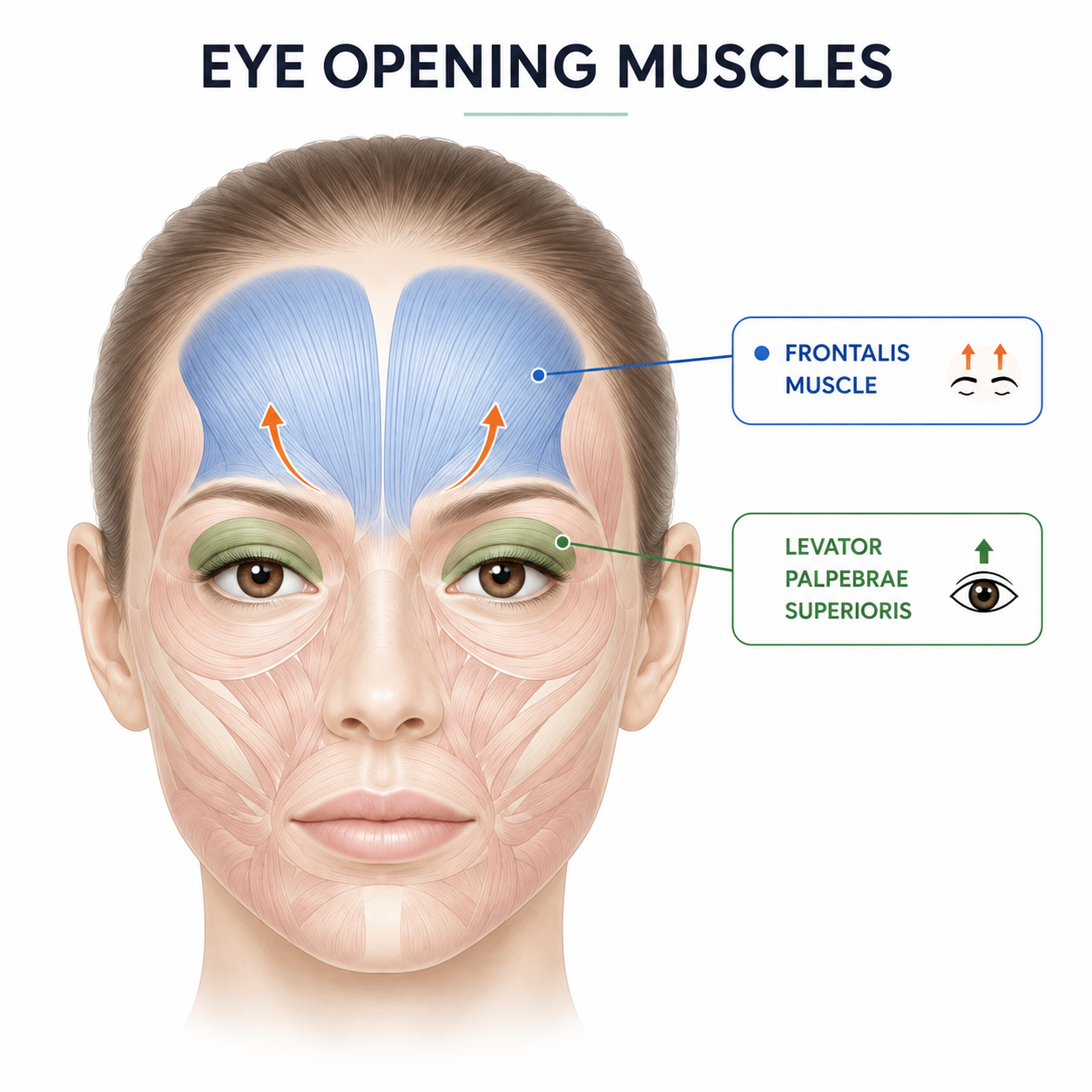
In most cases, the sensation of heavy eyelids occurs because the forehead muscles become relaxed—not because the Botox has migrated into the eyes.
The primary muscle responsible for opening the upper eyelid is the levator palpebrae superioris.
However, some people also use the frontalis muscle to help lift their eyebrows while opening their eyes.
If you naturally rely on your forehead muscles to assist with eye opening, relaxing those muscles with hongdaebotox may temporarily make your eyelids feel heavier or more difficult to open.
| Eye-Opening Pattern | Characteristics |
|---|---|
| Levator-dominant | Opens the upper eyelid naturally |
| Frontalis-assisted | Raises the eyebrows to help open the eyes |
| After Forehead Botox | Reduced frontalis activity may make the eyelids feel heavier |
Why Do We Use the Forehead Muscles More as We Age?

As the eyelids become heavier with age, some people naturally begin using their forehead muscles to help keep their eyes open.
With aging, the skin gradually loses elasticity, and the upper eyelids may become heavier due to changes in the skin and surrounding tissues.
To compensate, many people unconsciously raise their eyebrows by activating the frontalis muscle.
Over time, repeated forehead muscle contraction can create horizontal forehead lines and make existing wrinkles more noticeable.
As a result, many patients seek forehead Botox to soften these forehead wrinkles.
However, individuals who have relied on their frontalis muscles for years may be more likely to notice a temporary feeling of heavier eyelids after hongdaebotox.
What Should Be Evaluated Before Forehead Botox?

Forehead wrinkles are only one part of treatment planning. Your natural eye-opening pattern and facial muscle movement should also be evaluated.
The same injection pattern is not appropriate for everyone.
Factors such as eyelid heaviness, eyebrow position, forehead muscle activity, and facial anatomy vary from person to person.
A personalized treatment plan based on your facial anatomy and muscle movement is an important part of achieving natural-looking hongdaebotox results.
Frequently Asked Questions (FAQ)

Q. How long does the heavy eyelid sensation last after forehead Botox?
A. The duration varies from person to person. Many patients gradually adapt to the change, and the sensation often improves as the Botox effect naturally decreases over time. If the discomfort persists or significantly interferes with daily activities, consult the medical provider who performed your treatment.
Q. Can I receive forehead Botox if I have mild eyelid drooping (ptosis)?
A. In many cases, yes. However, your physician should carefully evaluate your eyelid condition, facial anatomy, and the way you naturally open your eyes before determining the most appropriate treatment plan.
Q. When can I wash my face or exercise after forehead Botox?
A. Gentle cleansing and normal daily activities are generally possible. However, on the day of treatment, it is recommended to avoid alcohol, saunas, hot baths, strenuous exercise, and excessive pressure or massage over the treated area.

A heavy eyelid sensation after forehead Botox does not necessarily mean that the Botox has spread into the eyes.
The way you naturally open your eyes, the condition of your eyelids, and your facial muscle activity all play an important role in how you experience treatment.
For this reason, forehead Botox should not be planned based solely on the location of forehead wrinkles. A comprehensive assessment of facial anatomy, eyebrow position, and muscle movement is an important part of personalized treatment planning.
If you are considering hongdaebotox, consult with a qualified medical professional to determine a treatment plan tailored to your individual facial anatomy and muscle function.
Author | Dr. Yumin Lee
Medical Institution | MeSOnBOM Clinic